Roof Repairs
Repairs across Hornsby and the Upper North Shore, where gutters and valleys blocked under heavy canopy cause most water entry.
Learn more →Roofs here sit under heavy canopy and back onto Ku-ring-gai Chase and the Berowra Valley. We find the actual fault, then quote it in writing. Free inspection.
A tile on the lawn after a windy night, or a brown ring creeping out across the ceiling cornice. That is usually what starts the call. Phone (02) 9000 1127 and we will come and look at it properly, for free.
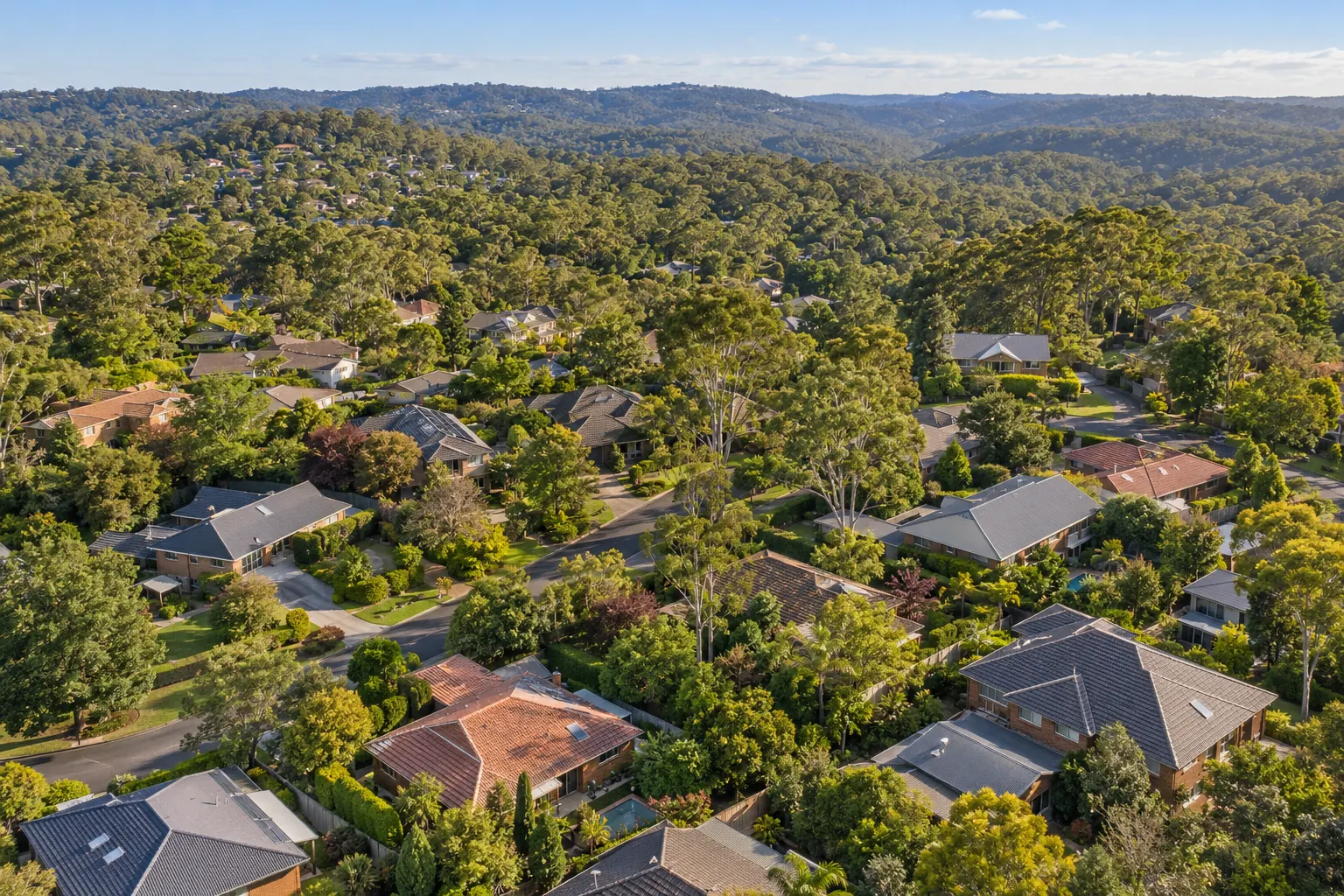
Roofs between Beecroft and Brooklyn live a harder life than most Sydney roofs. Around two-thirds of Hornsby Shire is bushland, by the Council's own bushland reporting, and the suburbs sit inside it rather than beside it: Ku-ring-gai Chase National Park holds the eastern and northern edge, the Berowra Valley runs down the middle to Berowra Creek, and Galston Gorge cuts across to the acreage country at Arcadia. It is beautiful, and it drops a great deal of organic matter on your roof every week of the year.
Across the Upper North Shore the same handful of problems account for the bulk of the work:
Almost none of that is dramatic. It is slow, it is cheap to fix early, and it is expensive once the ceiling is involved.
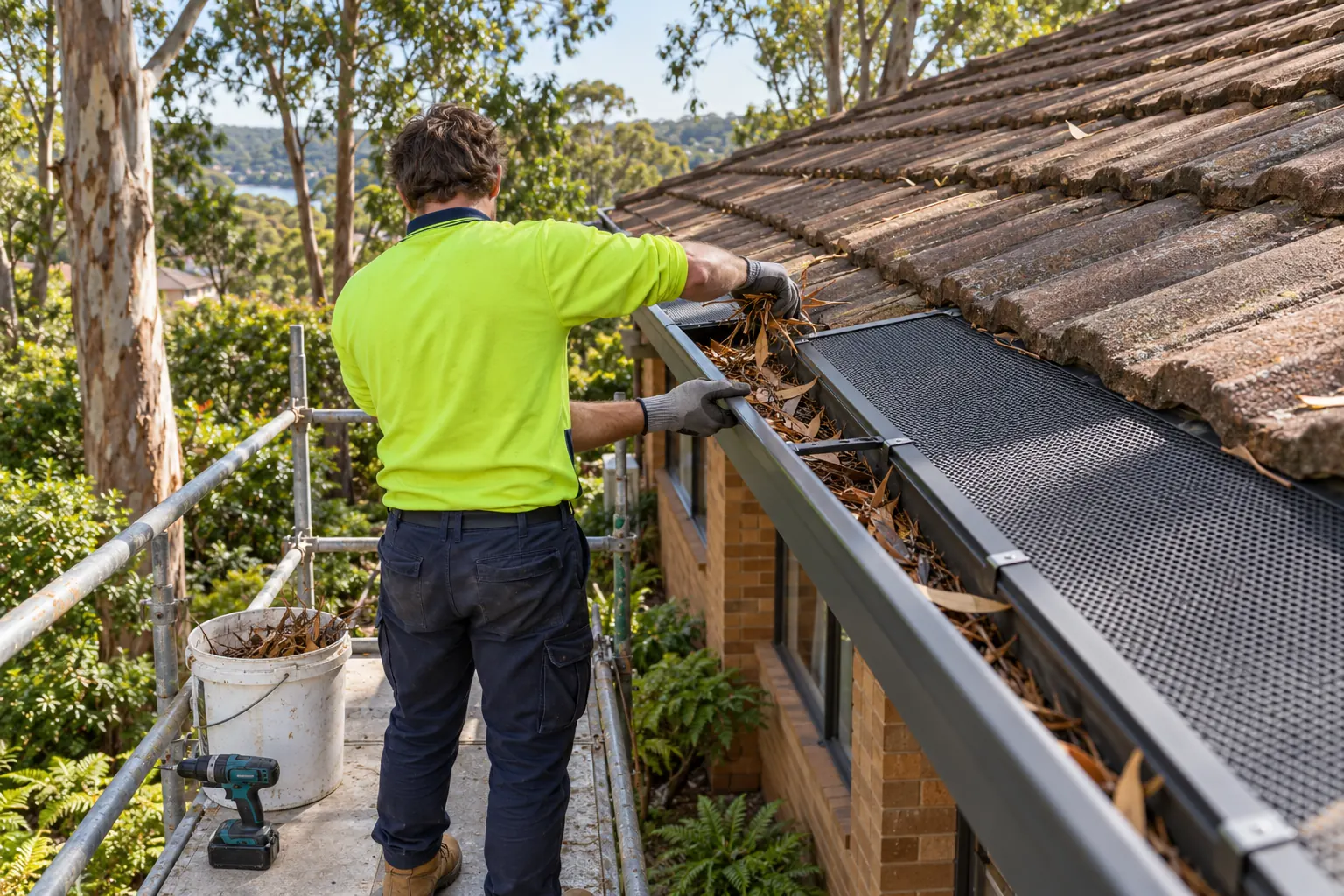
A gum leaf is not the problem. Ten thousand of them, wet, compressed and sitting against a steel gutter all winter, are the problem.
The mat holds moisture against the back of the gutter and the fascia, so rust starts where you cannot see it. In a tile valley it lifts the sheets of water sideways instead of letting them run, and once water crosses the edge of the valley tray it is inside the roof space. Under a metal roof it blocks the gutter outlet so the gutter overflows backwards under the sheet ends.
The repair is rarely exotic: clear it, flush it, check the valley tray for pinholes and corrosion, re-lay the tiles against the valley with the correct gap, and then make a decision about leaf guard based on what is actually growing above the house. A canopy of stringybarks needs a different answer from a couple of ornamental trees in a Waitara courtyard.
Berowra, Mount Kuring-gai, Cowan, Brooklyn, Hornsby Heights, Westleigh and the acreage blocks out at Arcadia and Fiddletown include a great deal of land mapped as bushfire prone. Hornsby Shire's maps are certified by the NSW Rural Fire Service and they drive how new roof work has to be built under AS 3959.
The roof-line details that matter are unglamorous and worth getting right: full sarking under tiles, roof-to-wall junctions sealed, valley and gutter guards in non-combustible material, and fine-aperture ember mesh rather than a plastic clip-in product that will not do the job. We raise this at the inspection and put it in the quote in plain terms. See gutter repair and leaf guard for how that is specified.
What is on your roof depends mostly on when your street was built.
The Federation and inter-war houses through Beecroft, Cheltenham, Wahroonga and Normanhurst are often under Marseille-pattern terracotta, which lasts remarkably well but is unforgiving of foot traffic and runs out of matching stock. The post-war and 1960s-70s brick homes across Asquith, Mount Colah, Berowra Heights and Hornsby Heights are mostly concrete tile, which is where most of our roof restoration work happens. Later additions, carports and the acreage houses and sheds out at Arcadia are usually metal, and that is where Colorbond re-roofing comes in.
On a steep, treed block, the practical argument for metal is that leaves slide off it. The argument for staying with tile is matching the street, which matters more than usual inside the Beecroft and Cheltenham heritage conservation area.
We will not quote a roof over the phone, because the number would be fiction. What moves the price is roof size, pitch, the material, access, and how far the damage has already travelled. A steep Hornsby Heights roof with a two-storey drop on three sides and a tree canopy in the way takes longer to work safely than a single-storey Waitara roof you can reach off a ladder. Bushfire-prone detailing adds cost too, and it belongs in the quote rather than in a conversation later.
The inspection is free and the quote is in writing, so you can compare it against anything else you have.
If you have a stain, a drip, a tile down or a gutter that has not been clear in years, the cheapest moment to deal with it was last season and the second-cheapest is now.
Call (02) 9000 1127 or request a free quote. We work right across Hornsby and the Upper North Shore, from Beecroft and Cheltenham up through Hornsby, Berowra and Cowan to Brooklyn on the Hawkesbury.
A no-cost inspection and a clear written quote — no pressure and no call-back pestering.
Work is carried out by established, licensed and insured roofing contractors working to NSW Fair Trading requirements.
Gutter guard and roof-line detailing appropriate to bushfire-prone land, discussed up front.
Every job carries a written workmanship warranty.
Repairs across Hornsby and the Upper North Shore, where gutters and valleys blocked under heavy canopy cause most water entry.
Learn more →Full re-roofing for Federation and mid-century homes on the large treed blocks around Hornsby.
Learn more →Colorbond roofing across Hornsby, Berowra and the Upper North Shore, including non-combustible detailing near bushland.
Learn more →Restoration for Hornsby tile roofs carrying years of leaf debris, moss and perished pointing.
Learn more →Gutter replacement and ember-rated leaf guard across Hornsby, where leaf load and bushfire risk are the same job.
Learn more →Storm and fallen-limb response across Hornsby and the Upper North Shore, make-safe first.
Learn more →Roof inspections and written reports across Hornsby, including gutter and roof-line assessments at the bushland interface.
Learn more →That pattern almost always points to a drainage fault rather than a hole. A valley half-packed with gum leaves, or a gutter sitting full of silt, will cope with a ten-minute shower and then back water up under the tiles once rain keeps falling for hours. The water finds the lap in the sarking or the top of a flashing and tracks inside. Clearing and re-detailing the valley usually fixes it permanently.
On the heavily treed streets through Normanhurst, Westleigh, Berowra Heights and Hornsby Heights, twice a year is the realistic minimum, and three times is common where eucalypts overhang the ridge. Stringybarks shed long ribbons that bridge straight across a gutter mouth, and the fine leaf litter that follows packs down into a wet mat. Properly specified leaf guard cuts the frequency down rather than removing the job entirely.
It can. Hornsby Shire publishes bushfire prone land maps certified by the NSW Rural Fire Service, and where new building work falls on that land it is assessed against AS 3959. In practice that means a fully sarked roof, sealed roof-to-wall junctions, non-combustible gutter and valley guards rather than plastic ones, and ember mesh with a fine aperture. We flag it at the inspection so it is in the quote, not a surprise later.
If the tiles themselves are sound and the problem is crumbling ridge pointing, perished valleys and a chalky surface, a restoration is usually the better spend and buys a long stretch of service life. Replacement makes more sense once tiles are widely cracked or delaminating, the battens are soft, or you have already paid for the same leak twice. We give you both numbers and the reasoning.
Yes. A pre-purchase roof inspection with photographs is one of the more useful things you can get on an older Upper North Shore house, because the roof is the part no one climbs during an open home. We report on tiles, pointing, flashings, valleys, gutters, sarking where visible, and anything that will need money in the next few years.
Tell us what you need and we'll get straight back to you. Prefer to talk? Call (02) 9000 1127 and speak to someone local.
Call (02) 9000 1127